
Executive Dysfunction in Adults with ADHD: Systems That Work With Your Brain
Executive Dysfunction Series: Part 2
Why Executive Dysfunction in ADHD Is So Often Misunderstood

Because ADHD isn’t outwardly visible, adults with ADHD are frequently blamed or judged for neurological symptoms. The lack of understanding of ADHD coupled with a lack of visible cues cause assumptions to be made about the challenges that individuals with ADHD face.
How Executive Dysfunction Shows Up in Daily Life for Adults with ADHD
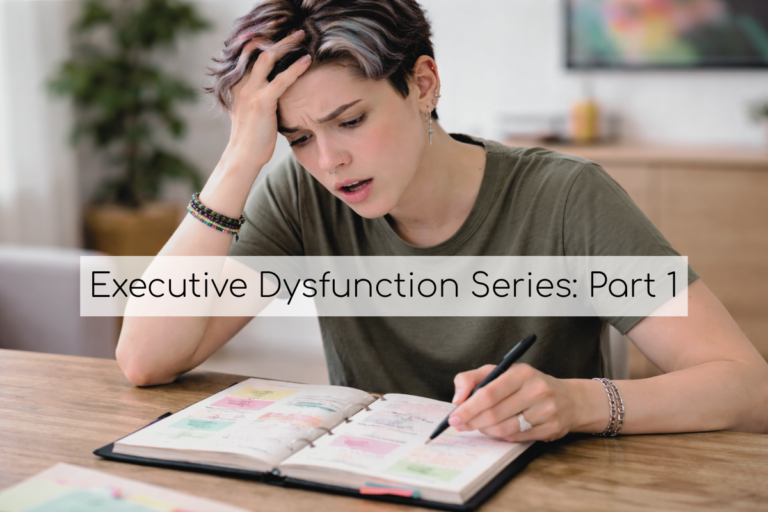
For adults with ADHD, executive dysfunction causes challenges on a day to day basis. Having difficulty with decision-making, fluctuations in energy levels, and trouble with productivity or sticking to a routine.
Common patterns include:
- Feeling overwhelmed by competing priorities
- Struggling to decide what to do first
- Difficulty maintaining routines even when they help
- Starting strong and burning out quickly
- Avoiding tasks not because they’re unimportant, but because they’re cognitively heavy
These challenges are not a reflection of poor planning or lack of effort. They’re a signal that activation, focus, or regulation systems are overloaded, and additional structure or support is needed.
This is why ADHD-friendly tools work best when they reduce decision-making, externalize executive function, and match energy to priority, rather than relying on internal motivation alone.
Supporting Executive Dysfunction in Adult ADHD (What Actually Helps)
Traditional productivity systems often fail adults with ADHD because they assume:
- consistent energy
- stable attention
- linear task execution
Neurodivergent individuals need productivity systems that work for their brain, and many systems have been created from a neurotypical lense.
Supportive approaches focus on:
- clarifying priorities
- reducing cognitive load
- creating flexible structure
- matching tasks to capacity
Rather than asking “How do I force myself to do this?”, a more helpful question is:
“What support does my executive system need right now?”
This is where intentional tools can make a meaningful difference.
Clarifying Priorities When Everything Feels Urgent
When activation and regulation are overloaded, it can feel like everything matters equally, which leads to shutdown or avoidance.
A neurodivergent-friendly priority system helps by:
- distinguishing urgency from importance
- reducing overwhelm
- offering a visual way to decide what actually needs attention today
➡️ Download the Neurodivergent Priority Scale made for ADHD brains.
Creating Routines That Work With ADHD (Not Against It)
Many adults with ADHD struggle to maintain routines—not because routines are unhelpful, but because rigid systems don’t adapt to fluctuating energy, focus, or nervous system state.
An ADHD-informed routine builder supports executive function by:
- offering flexible structure
- allowing routines to change day to day
- reducing decision fatigue
- focusing on consistency over perfection
➡️ Download the Neurodivergent Routine Builder.
Breaking Tasks Down When Initiation Feels Impossible
Task initiation is often the biggest executive hurdle for adults with ADHD. Large or undefined tasks can overwhelm activation systems before they even begin.
A supportive task planner helps by:
- breaking tasks into clear, manageable steps
- reducing working memory demands
- providing visible starting points
- making progress feel achievable
➡️ Download the Neurodivergent Task Planner.
Executive dysfunction in ADHD is not a personal failure—it’s a signal for support.
When activation, focus, or regulation are strained, the solution is not more pressure or self-criticism. It’s:
- clearer priorities
- external structure
- reduced cognitive load
- tools designed for neurodivergent brains
If executive dysfunction has been a source of frustration or shame, know this: your brain is not broken, it’s asking for support in a language that often goes unheard.
Executive dysfunction becomes more manageable when systems are designed to support the brain you have, not the one you’re told you should have.